 EN

On Amazon and various health-product platforms, the reviews for red-light therapy blanket reveal a stark divide. On one side, users claim, "It melted away the tension and soreness in my neck and shoulders," or "I’ve finally found a way to manage my knee osteoarthritis at home." On the other, users report, "After three weeks, there’s been no improvement in my arthritis," or "When set to the highest intensity, the wrap became painfully hot and caused blisters on my skin." For the same type of product, intended to address the same concerns, the user experiences couldn't be more polarized. This divide is no coincidence; it mirrors the current state of evidence for photobiomodulation (PBM) in the treatment of arthritis and muscle soreness—while the underlying mechanisms are plausible and some individuals do derive genuine benefit, the body of evidence as a whole falls far short of a consensus on its reliable efficacy.
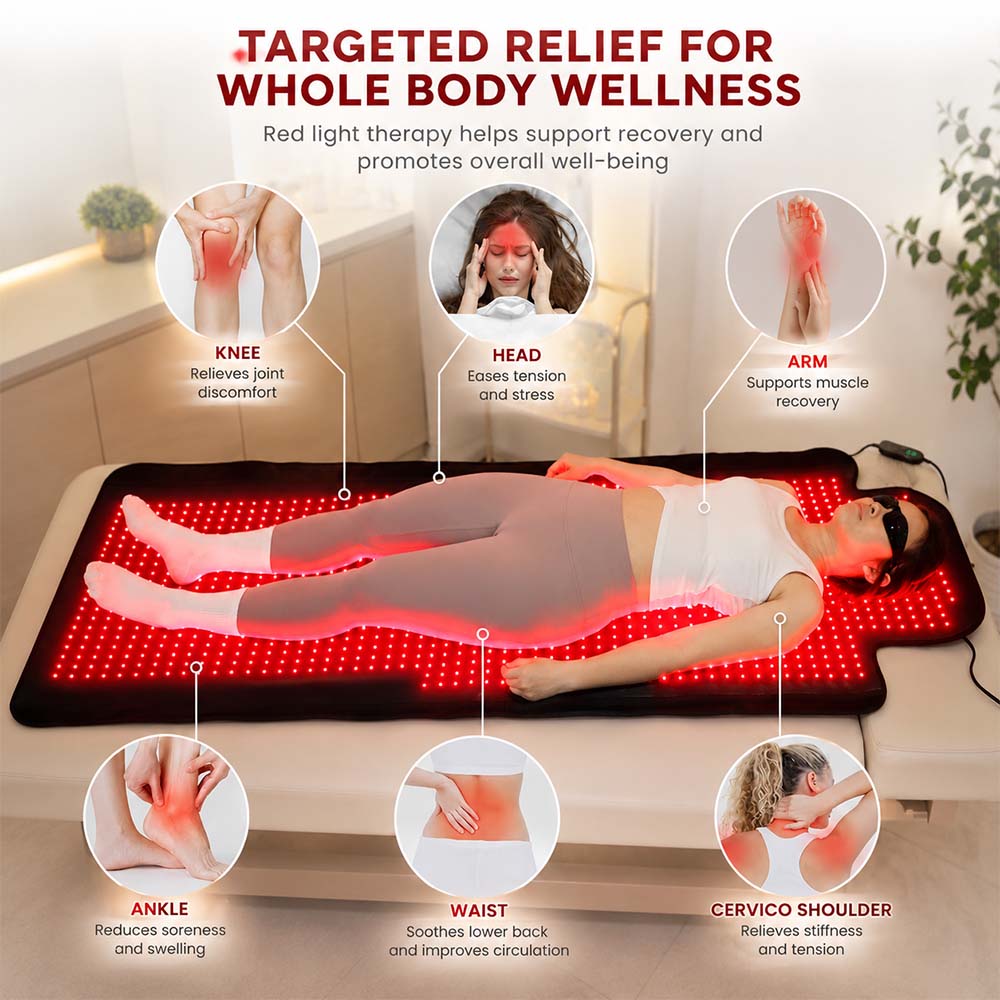
The Spectrum of User Feedback: From Relief to Burns
In publicly available reviews, positive feedback frequently highlights a sense of "relaxation" and "pain relief." One user described the experience as having "stress and muscle pain melted away," while others noted that red-light therapy helped alleviate the daily discomfort of knee osteoarthritis. Regarding post-exercise recovery, some users reported "reduced muscle soreness and faster recovery." Such feedback cannot be dismissed as a mere placebo effect—at the laboratory level, PBM has demonstrated biological activity in modulating inflammation and cellular energy metabolism.
Conversely, negative feedback serves as a critical warning. Reviews for several products contain clear reports of low-temperature burns: users described a "burning and itching sensation" in the treated area, with one individual reporting "small-area burns that developed into blisters" on their lower leg. Other reviews point out that some wrap-style or belt-style devices are too small, offering limited coverage, and lack battery-powered options, which significantly restricts how and where they can be used. Most concerning is the case of a patient with diabetic peripheral neuropathy who, due to reduced skin sensitivity, failed to notice the heat and suffered burns from the LEDs, forcing them to discontinue use. These observations point to a common issue: factors such as a device’s actual power density, thermal management design, and individual skin sensitivity are often—whether intentionally or inadvertently—downplayed in products designed as "blankets"—that is, devices intended for direct, large-area contact with the body.
Arthritis: Strongest Evidence Found in Osteoarthritis, Yet Not Endorsed by Clinical Guidelines
Within the spectrum of arthritis, the most robust body of evidence concerns knee osteoarthritis. A 2019 systematic review and meta-analysis published in *BMJ Open*—encompassing 22 randomized, placebo-controlled trials with 1,063 patients—found that photobiomodulation (PBM) yielded a large effect size for pain reduction (standardized mean difference of −1.14) and significantly improved functional impairment scores. These effects were even more pronounced in trials that utilized recommended dosage parameters, with near-infrared light at a wavelength of 850 nm proving most effective. Clinical case series on knee synovitis also suggest that red-light therapy, when used as an adjunct, helps reduce inflammation and improve function. Similarly, a 2025 meta-analysis in *Sports Health* indicates that, under specific protocols, PBM leads to "moderate improvements" in markers of muscle damage and delayed-onset muscle soreness.
However, the existence of evidence does not equate to its adoption in clinical guidelines. The latest guidelines from the American College of Rheumatology (ACR) and the Arthritis Foundation do not include PBM as a routine recommendation; meanwhile, the Australian RACGP guidelines even issue a "conditional recommendation against" the use of low-level laser therapy for knee osteoarthritis. An orthopedist—who reviewed the medical literature—candidly noted that while the current data are "insufficient to prove efficacy, that does not mean it is ineffective." The reason PBM has not been incorporated into arthritis treatment guidelines is the significant heterogeneity across studies—regarding wavelengths, dosages, and devices—which renders the overall certainty of the evidence insufficient to support broad clinical recommendations. For rheumatoid arthritis, the evidence is even more limited; although there are some encouraging preliminary signals, it is far from reaching the threshold required to alter standard treatment pathways.
It must be clearly understood that red-light therapy blanket do not repair cartilage, nor do they alter the structure of a joint. Orthopedists emphasize that "there is absolutely no evidence to suggest that at-home red-light therapy devices can regenerate cartilage lost in end-stage knee osteoarthritis." Such devices should be viewed as an adjunctive tool for symptom management, rather than as a disease-modifying treatment.
Muscle Soreness: Weaker Evidence, No "Reliable Reduction"
Compared to its application for arthritis, the evidence base for red light therapy in addressing post-exercise muscle soreness is even thinner. Examine.com, an independent organization that evaluates supplements and health information, concludes quite bluntly: red light therapy "does not appear to reliably reduce muscle soreness" in the days following exercise. Most research supporting its use for recovery involves small-scale, short-term studies, where observed effects are characterized as "modest improvements" rather than significant performance gains or the elimination of pain.
While some meta-analyses have reported that photobiomodulation (PBM) can reduce delayed-onset muscle soreness (DOMS) within 72 hours post-exercise and improve strength performance within 96 hours, these findings are highly dependent on the specific timing and protocol—requiring a precise combination of pre- and post-exercise application, sufficient energy density, and the correct wavelengths. In other words, even if benefits exist, they are conditional: the therapy may offer limited help to certain individuals under specific parameters, rather than serving as a universal recovery tool that works effectively for everyone the moment it is used.
The mechanism is sound, but a gap—defined by device variability—separates "sound" from "effective."
The core mechanism of photobiomodulation (PBM) is grounded in solid laboratory research: red light (near 660 nm) and near-infrared light (near 850 nm) are absorbed by cytochrome c oxidase within the mitochondria. This activates mitochondrial function and boosts ATP synthesis, while simultaneously inhibiting the NF-κB pathway, suppressing pro-inflammatory cytokines—such as TNF-α, IL-1β, and IL-6—and reducing COX-2 activity. At the molecular pathway level, these are indeed valid targets for addressing inflammation and pain.
The challenge, however, lies in the transition "from the laboratory to the living room." The specific parameters that yield positive results in a lab setting—such as precise irradiance, energy density, irradiation distance, and duration—are extremely difficult for an average user to verify in consumer-grade products. An industry professional with 15 years of experience in manufacturing phototherapy devices notes that many "blanket-style" products on the market lack sufficient irradiance; even when in direct contact with the skin, they fail to deliver an effective dose, rendering them potentially far less effective than a high-quality panel-style device. Furthermore, low-cost products often pose additional risks related to electrical safety and temperature control. Dr. Matthew Harb’s observations align with this: "Some patients do experience genuine relief, while others see no benefit despite diligent use. The inconsistency in research findings is partly due to the fact that these studies utilize vastly different wavelengths, dosages, and devices."
Safety Boundaries: Generally Safe for Most Adults, with Key Limitations
An evidence-based guideline published in 2025—derived from a systematic literature review and a Delphi consensus—concluded that photobiomodulation (PBM) is a safe treatment modality for adults, with red-light PBM shown not to induce DNA damage. However, this does not mean that usage conditions can be disregarded. The consensus and safety reviews repeatedly emphasize several contraindications and precautions: direct exposure to the eyes must be avoided (protective eyewear is essential); individuals with diminished skin sensation (such as those with diabetic neuropathy or spinal cord injuries) face a significantly higher risk, as they may not be able to detect overheating in time; those who are photosensitive, suffer from certain skin conditions or autoimmune diseases, or are undergoing cancer treatment should consult a physician before use; and the safety of PBM for children and adolescents has not yet been established. Instances of burns and blisters reported by users are, in large part, a consequence of these safety boundaries being obscured by product marketing and usage instructions.
A Pragmatic Conclusion: It Might Work, But Don’t Pay a Hefty Premium for a "Maybe"
When weighing user feedback against scientific evidence, the reality of red-light therapy blankets can be summarized in three points: For some patients with knee osteoarthritis, they may provide clinically meaningful pain relief—though this effect has not been incorporated into mainstream arthritis clinical guidelines. For post-exercise muscle soreness, the evidence is even weaker and highly dependent on specific device parameters, making reliable results far from guaranteed. Furthermore, there is immense variation between devices in terms of power output, wavelength accuracy, and safety; the polarized nature of user reviews largely reflects the vast differences in product quality rather than the efficacy of the therapy itself.
A physician’s summary perhaps offers the most honest consumer advice: "I wouldn't strongly recommend it, but I’m not against you giving it a try. What I really want to protect you from is the high price tag." If you decide to try one, prioritize products that clearly specify a combination of 660 nm and 850 nm wavelengths, provide verifiable irradiance data, and include temperature controls or overheating protection. Start with lower intensity settings and shorter durations, and always wear protective eyewear. Most importantly, view this as an adjunct to your existing treatment plan—never as a replacement for exercise, weight management, physical therapy, or medications prescribed by your doctor. This is especially critical for those with arthritis: no home-use red-light blanket has been proven to alter the structural progression of joint disease. While temporary symptom relief is welcome, it is no justification for abandoning evidence-based medical care.