 EN
EN

From the Lab to the Home: The Smart Red and Infrared Therapy Wrap Redefines Home Therapy with Dual-Wavelength Phototherapy!
Once upon a time, phototherapy was the "exclusive treatment" of hospital rehabilitation departments and professional clinics—patients needed to regularly visit medical institutions to receive treatment under expensive professional equipment. Now, with the maturity of LED phototherapy technology and the arrival of the home-use trend, red and infrared phototherapy is entering thousands of households at an unprecedented speed. According to industry data, the global market size of home phototherapy devices reached 13.58 billion yuan in 2025 and is expected to exceed 25 billion yuan by 2032. In this trend, the smart red and infrared therapy wrap, with its dual-wavelength phototherapy technology, is redefining the possibilities of "home therapy."
The Principle of Phototherapy: From "Light" to "Cellular Energy"
To understand why the smart red and infrared therapy wrap is effective, we first need to understand the core mechanism of phototherapy—photobiomodulation (PBM).
Simply put, light of a specific wavelength can penetrate the skin and be absorbed by the mitochondria within human cells. Mitochondria are known as the cell's "energy factories." When photons from red and near-infrared light interact with cytochrome c oxidase within the mitochondria, they stimulate the mitochondria to utilize oxygen more efficiently, producing more adenosine triphosphate (ATP)—the cell's "energy currency." With more energy, cells can better perform their repair, regeneration, and metabolic functions.
This mechanism is not mystical but has been scientifically validated over decades. Research has confirmed that the combination of red and near-infrared light has positive effects on improving cellular insulin signaling and regulating mitochondrial function. For this reason, photobiological therapy has been widely used internationally in areas such as tissue repair, inflammation control, and pain management.
Dual-Wavelength Specialization: Red Light for "Surface Repair," Infrared Light for "Deep Conditioning"
The ingenuity of the intelligent red-infrared therapy wrap lies in its integration of two different wavelengths of light—visible red light and invisible near-infrared light—into a single device, achieving a synergistic effect where each wavelength performs its specific function.
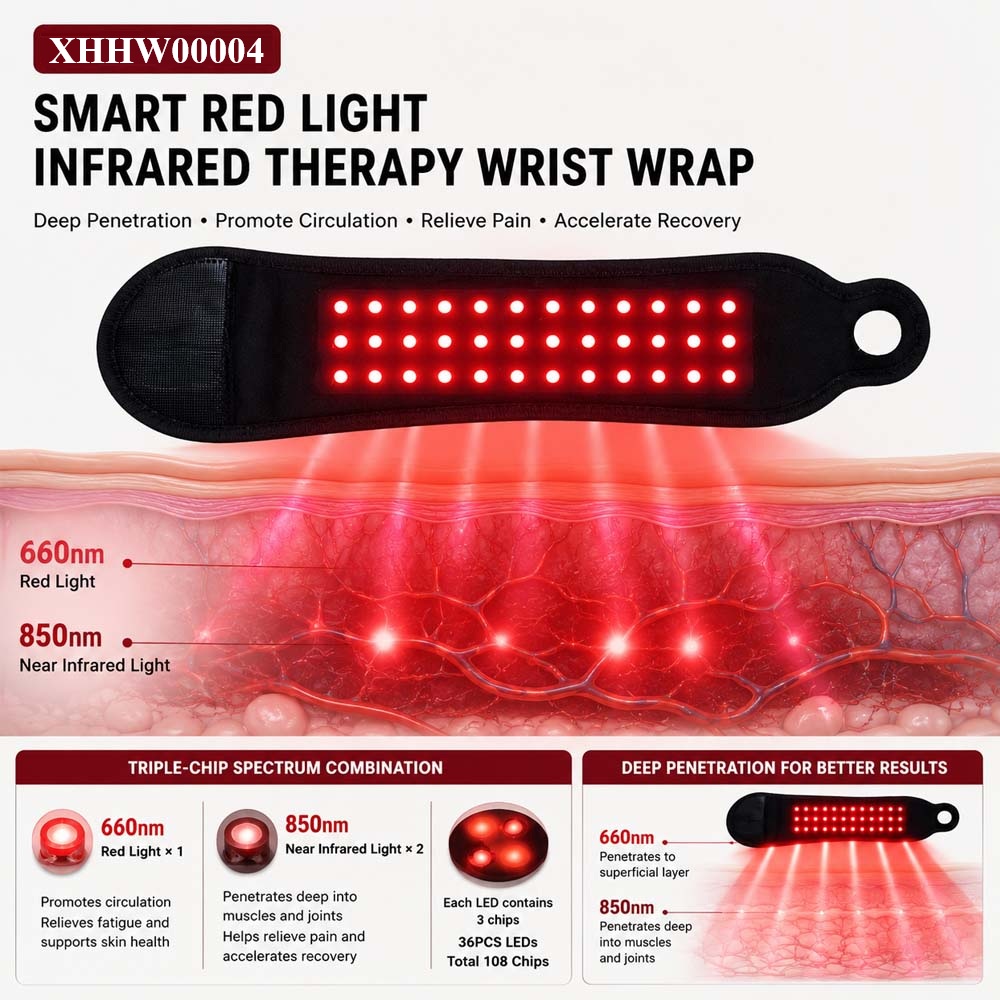
Red light (typical wavelength 660nm) primarily acts on the skin's surface and superficial tissues, penetrating to a depth of approximately 8-10 millimeters. It is efficiently absorbed by skin tissue and is particularly effective in promoting collagen and elastin production, improving skin texture, and accelerating the healing of superficial wounds. Simply put, red light is responsible for "surface repair."
Near-infrared light (typical wavelengths 850nm or 940nm) extends beyond the visible spectrum. It has stronger penetrating power, reaching deep into the skin and directly into muscles, joints, and bone tissue. Near-infrared light is ideal for enhancing muscle recovery, reducing joint pain, and repairing deep tissues. It is responsible for "deep conditioning."
When 660nm red light and 850nm (or 940nm) near-infrared light work synergistically in the same device, full-layer coverage from the epidermis to the deep layers is achieved. This dual-wavelength design allows a small therapy wrap to address multiple needs, from skin repair to muscle relaxation, from inflammation relief to joint maintenance.
From Lab to Home: The Breakthrough Path of Smart Therapy Wraps
In the past, dual-wavelength phototherapy devices were bulky and expensive, only available in professional institutions. Today, smart red-infrared therapy wraps condense this technology into lightweight, soft, and wearable home devices, allowing everyone to enjoy a professional-grade phototherapy experience in their own living room.
Take the smart red-light therapy waist belt from Xiamen Weiyou Intelligent Technology Co., Ltd. as an example. It typically uses a flexible material design, allowing for flexible wrapping of multiple body parts such as the waist, shoulders, neck, back, and knees. It contains dozens to hundreds of dual-core LED beads, simultaneously emitting 660nm red light and 850nm near-infrared light. Users simply place the therapy wrap close to the skin and secure it with Velcro to begin use. The device features intelligent timer control (such as automatic shutdown after 20-30 minutes), multiple mode switching (such as pure red light mode, pure infrared mode, and mixed mode), and adjustable light intensity, making it so simple that even the elderly can easily use it.
More importantly, these red light therapy devices mostly adopt a wireless charging design, making them lightweight and portable. Whether it's lower back pain after prolonged sitting at an office, muscle fatigue after exercise, or everyday neck and shoulder stiffness, users can enjoy a "light therapy spa" anytime, anywhere. The intelligent red light infrared therapy wrap transforms professional light therapy from "going to the clinic" to "doing it at home," and from "regular treatments" to "daily habits."
Market Trends: The Era of Home Light Therapy Has Arrived
This transformation is not accidental. Data shows that the global LED spectral therapy device market will reach approximately $469 million in 2025 and is projected to reach $867 million in 2032, with a compound annual growth rate of 9.3%. In the Chinese market, home LED light therapy devices are experiencing rapid growth, with the market size for home LED light therapy beauty devices projected to reach 19.26 billion yuan in 2025.
The core driving force behind this growth is the shift in consumers' health management philosophy from "passive treatment" to "proactive prevention." People are no longer satisfied with "treating illness only after it occurs," but rather want to proactively maintain their physical condition in daily life. The intelligent red-infrared therapy wrap perfectly meets this need—it's safe, non-invasive, and causes no heat damage. Its radiation intensity is typically kept within safe limits, and unlike ultraviolet light, it won't damage the skin, making it ideal for long-term home use.
Meanwhile, wearable forms are rapidly gaining popularity. The sales share of portable phototherapy products such as face masks, neck and shoulder patches, and waist belts continues to rise. It's foreseeable that products like the intelligent red-infrared therapy wrap will become a "health standard" for more families in the future.
Conclusion
From a sophisticated laboratory instrument to a daily companion in the home, the intelligent red-infrared therapy wrap bridges the gap with dual-wavelength phototherapy technology—one end is the scientifically validated principle of photobiological regulation, and the other end is a health management method accessible to every ordinary person.
660nm red light handles surface repair, while 850nm near-infrared light handles deep conditioning. Together, they cover multi-level needs from skin to muscles, from joints to tissues. This is no longer exclusive to medical institutions, but a daily therapy solution that every family can have.
When phototherapy moves out of the laboratory and into everyday life, it changes not only the popularization of a treatment method, but also our understanding of "health management" itself—health can be simpler, more everyday, and more accessible.