 EN
EN

Cold compression therapy is gaining attention as a practical recovery option for athletes, sports clinics, physiotherapy centers, and active individuals. By combining controlled cooling with targeted compression, this approach is designed to provide a convenient way to manage post-exercise discomfort and support recovery routines.
From professional sports teams to fitness and rehabilitation settings, recovery is becoming an increasingly important part of training. But why is cold compression therapy attracting so much interest?
Here are five key reasons.
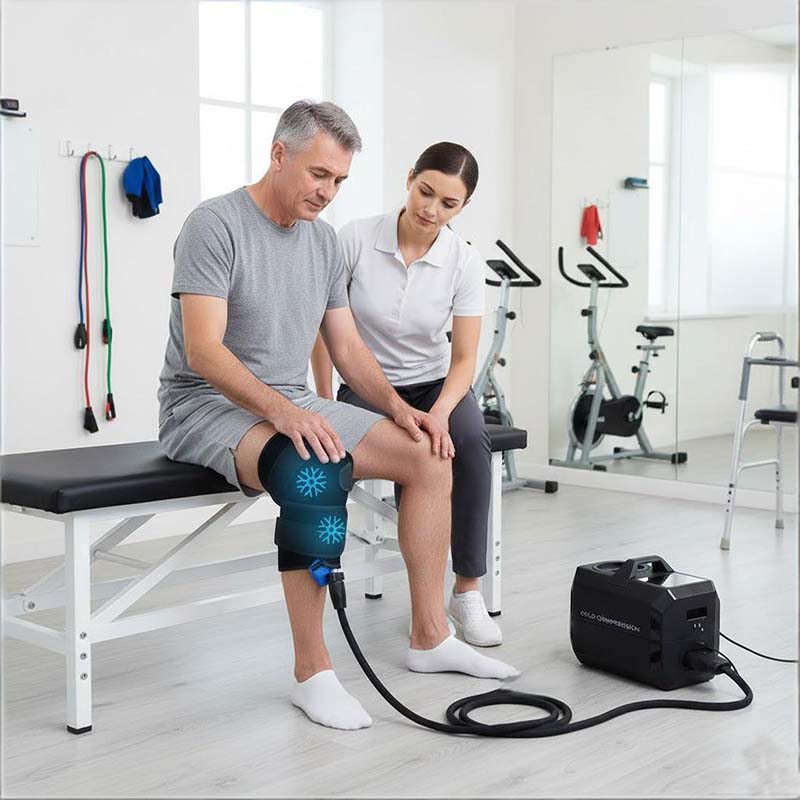
Traditional recovery methods often use cold therapy and compression separately. Cold compression therapy brings the two approaches together in one system.
Cooling can temporarily reduce tissue temperature and provide an analgesic effect, while compression applies controlled pressure around the targeted body area.
This combination makes cold compression therapy particularly attractive for users who want a more structured recovery session rather than simply applying an ice pack.
Recent research continues to investigate how different cold-therapy approaches influence soreness, muscle function, and post-exercise recovery. A 2024 systematic review and meta-analysis found that cryostimulation can reduce perceived muscle pain and fatigue, although effects on exercise performance are less consistent.
Muscle soreness is one of the most common concerns after demanding training sessions, competitions, or unfamiliar exercise.
Cold therapy is widely used in sports settings because cooling can temporarily reduce pain sensation. Research published in the British Journal of Sports Medicine notes that the analgesic effect of cryotherapy is one of its established uses in sports medicine, although evidence for other proposed effects, such as preventing secondary tissue injury or improving tissue regeneration, is more limited.
A 2024 network meta-analysis involving 57 studies and 1,220 healthy participants reported that cryotherapy showed favorable results for delayed-onset muscle soreness and some measures of neuromuscular recovery.
For athletes, this means cold therapy may be useful as part of a broader recovery routine, particularly when soreness is a major concern.
Athletes often have limited recovery time between training sessions, games, races, or competitions.
This makes convenient recovery technologies increasingly attractive.
Cold compression systems can be designed for targeted areas such as the knee, shoulder, leg, arm, or other commonly treated regions, allowing users to incorporate recovery sessions into sports clinics, training facilities, rehabilitation centers, and home-care environments.
For team sports in particular, recovery strategies are increasingly being evaluated according to practical factors such as timing, athlete preference, workload, and the next scheduled activity.
A recent systematic review of recovery strategies in soccer players found that cold-water immersion was associated with improvements in several perceived recovery measures, while also emphasizing substantial differences between studies and the importance of individualized recovery strategies.
Cooling is only one part of modern recovery technology.
Compression-based recovery has also attracted considerable research interest. A 2024 systematic review and meta-analysis of intermittent pneumatic compression included 17 studies involving 319 participants. The researchers reported small or variable effects on muscular function and more noticeable potential benefits for perceived pain and soreness.
This helps explain why combination devices are becoming increasingly interesting to sports and rehabilitation professionals.
Instead of relying on a single recovery modality, cold compression equipment can integrate temperature management and controlled compression into one treatment platform.
For equipment manufacturers and distributors, this also creates opportunities to develop different sleeve configurations, pressure settings, cooling systems, and treatment protocols for different application scenarios.
Modern athletes do not necessarily follow one universal recovery routine.
Training intensity, competition schedules, body area, injury history, individual tolerance, and recovery goals can all influence which recovery method is selected.
This is one reason customizable recovery equipment is gaining attention.
Cold compression devices can potentially offer adjustable parameters such as:
For professional sports organizations, physiotherapy clinics, rehabilitation centers, and sports recovery businesses, adjustable systems can provide greater flexibility across different users and applications.
The growing interest in cold compression therapy does not mean that it should be considered a universal solution for athletic recovery.
Current research suggests that cold-based recovery methods may help reduce perceived muscle soreness and pain, while their effects on strength, performance, inflammation, and long-term recovery can vary depending on the intervention, timing, population, and outcome being measured.
For example, a 2026 systematic review of post-match cold-water immersion in trained soccer players found improvements in some measures of muscle strength, jump performance, muscle damage, and soreness, but sprint performance was not improved and the authors advised cautious interpretation because prediction intervals included the possibility of no effect.
Therefore, cold compression therapy is best considered one component of a comprehensive recovery strategy, rather than a replacement for appropriate training management, rest, hydration, nutrition, rehabilitation, or professional medical assessment when required.
As sports recovery becomes more data-driven and personalized, the demand for convenient and controllable recovery technologies is likely to continue attracting attention.
For sports clinics, physiotherapy providers, rehabilitation centers, fitness facilities, and professional teams, cold compression equipment offers a practical platform that combines two established recovery modalities in a single system.
For manufacturers and distributors, the opportunity goes beyond the device itself. Features such as multiple sleeve options, adjustable compression, temperature control, portable designs, digital controls, and OEM & ODM customization can help create solutions for different markets and business models.
VU develops intelligent rehabilitation and physiotherapy equipment for professional and commercial healthcare applications.
Its cold and hot compression therapy solutions are designed around controlled temperature management, compression therapy, multiple sleeve configurations, and flexible application options.
For distributors, rehabilitation equipment suppliers, sports recovery centers, physiotherapy clinics, and healthcare brands, VU also provides OEM & ODM customization, including product appearance, color, functions, sleeve configuration, logo, packaging, and other product requirements.
As sports recovery continues to evolve, the combination of cooling + compression + customization represents an increasingly practical direction for modern recovery equipment.
Cold compression therapy combines controlled cooling with compression around a targeted body area. It is commonly used as part of post-exercise recovery and sports rehabilitation routines.
Research suggests that cold-based recovery methods may help reduce perceived muscle soreness and pain, but the effects on athletic performance and other recovery outcomes vary between studies. It should be used as part of an individualized recovery strategy.
An ice pack mainly provides passive cooling. Cold compression equipment can combine controlled cooling with adjustable compression and a defined treatment duration, providing a more structured recovery session.
Cold compression technology is used in sports recovery, physiotherapy, rehabilitation, fitness, and other professional settings. Appropriate use depends on the individual, the body area being treated, and professional guidance where necessary.
No. Cold compression should generally be viewed as a complementary recovery modality rather than a replacement for rehabilitation, exercise programming, rest, nutrition, or professional medical care.
Cold compression therapy is becoming increasingly visible in sports recovery because it combines cooling, compression, convenience, and adjustable treatment options in one recovery platform.
While scientific evidence supports potential benefits for soreness and selected recovery outcomes, results are not uniform across all athletes or situations. The most appropriate approach is therefore to integrate cold compression into a broader, individualized recovery program.
For sports recovery businesses and healthcare equipment providers, this evolving category also creates new opportunities for professional equipment development, customized solutions, and OEM & ODM partnerships.
Xiamen Weiyou Intelligent Technology Co., Ltd is committed to helping global partners develop intelligent rehabilitation and recovery solutions through reliable manufacturing, product customization, and OEM & ODM cooperation.