 EN

Choosing the right compression therapy device is an important decision for rehabilitation clinics, physical therapy centers, and specialized healthcare facilities. The right equipment should not only meet the clinic's treatment requirements but also support efficient workflows, accommodate different patient needs, and provide long-term operational value.
With the growing range of pneumatic compression therapy systems available on the market, clinic owners and healthcare professionals may find it challenging to identify the most suitable solution. From chamber configurations and pressure adjustment to sleeve compatibility, safety compliance, and manufacturer support, several factors deserve careful consideration.
This guide explores how to select the right compression therapy equipment for a rehabilitation clinic and what healthcare providers should evaluate before making an investment.
The first step is to identify the clinical applications and patient populations your rehabilitation clinic serves.
Pneumatic compression therapy devices use controlled air pressure to inflate and deflate multiple chambers within specialized sleeves. This sequential compression applies external pressure to selected body areas and may be used as an adjunct in lymphedema management, subject to clinical judgment and individual patient factors.
Depending on the clinic's services, potential applications may include:
Lymphedema management: Supporting clinician-directed treatment programs for patients with lymphedema.
Upper-limb treatment: Providing compression coverage for the arm and related areas using compatible arm sleeves.
Lower-limb treatment: Supporting treatment protocols involving the legs and feet with dedicated compression boots or leg sleeves.
Trunk and waist coverage: Offering additional compression coverage with compatible waist garments or full-body configurations.
Clinics should evaluate their patient profiles, treatment protocols, and professional requirements before selecting a device. Equipment selection should always be consistent with the manufacturer's intended use and applicable clinical guidelines.
The number of air chambers is one of the most important technical considerations when selecting a pneumatic compression therapy system.
Different chamber configurations provide different compression coverage and control options.
4-Chamber Compression Therapy Systems
Four-chamber devices provide a relatively straightforward compression configuration and may be suitable for clinics seeking a basic system for specific treatment requirements.
6-Chamber Compression Therapy Systems
Six-chamber systems offer additional compression zones and can support a wider range of sleeve configurations, depending on the device design.
8-Chamber Compression Therapy Systems
Eight-chamber systems provide more segmented compression coverage and can be considered by clinics requiring flexible treatment configurations for different body areas.
12-Chamber Compression Therapy Systems
Twelve-chamber systems offer multiple compression zones and may include more advanced pressure-control functions. Certain models allow individual chamber pressure adjustment, providing greater flexibility for clinician-directed treatment settings.
When comparing devices, clinics should look beyond the chamber count. They should also evaluate the inflation sequence, pressure adjustment range, available modes, treatment duration settings, and whether the system supports the required treatment protocols.
Different patients may require different treatment parameters. Therefore, adjustable pressure and treatment settings are essential considerations.
When evaluating a compression therapy machine, check the following functions:
Adjustable pressure: Allows clinicians to select appropriate pressure settings within the device's specified operating range.
Multiple treatment modes: Provides different compression sequences for different treatment requirements.
Adjustable treatment duration: Enables users to configure session times according to professional recommendations.
Individual chamber control: Available on selected advanced systems, allowing pressure adjustment for specific compression zones.
Memory function: Helps retain frequently used settings on compatible models.
A device with flexible controls can help clinics establish more consistent operating procedures while accommodating different treatment configurations.
However, more functions do not automatically mean better clinical suitability. The most appropriate device is the one that matches the clinic's intended applications and professional requirements.
Sleeve compatibility directly affects how effectively a clinic can organize its equipment for different treatment areas.
Rather than purchasing several independent machines, rehabilitation clinics may benefit from selecting a compression system that supports multiple interchangeable sleeve options.
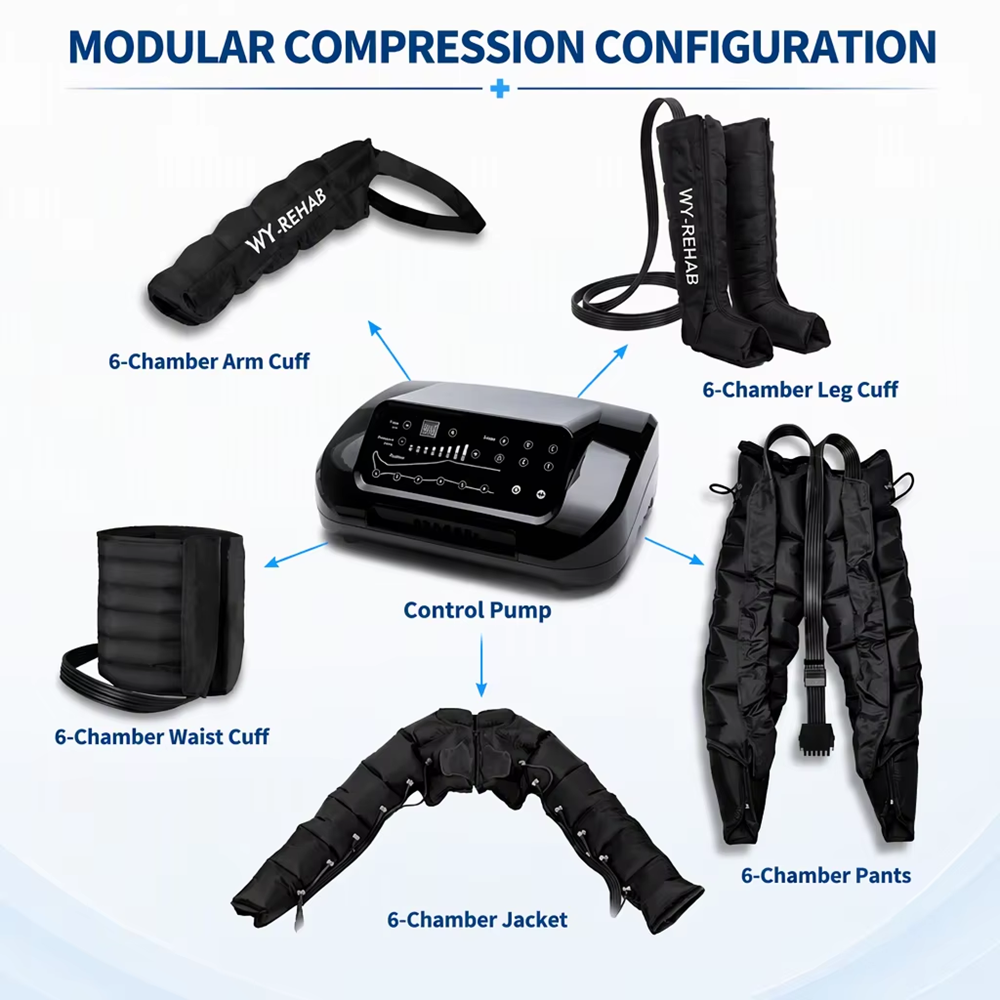
Common sleeve configurations include:
Leg Compression Boots: Designed for foot and leg coverage.
Full-Length Compression Pants: Extend coverage from the feet through the legs to the waist, depending on the garment design.
Arm Compression Sleeves: Designed for upper-limb compression applications.
Waist Compression Sleeves: Provide compression coverage around the waist and abdominal region.
Compression Jackets: Offer broader upper-body coverage, depending on the garment configuration.
Some systems also support combined sleeve configurations, allowing compatible garments to be used together or independently.
For clinics managing different treatment requirements, multi-sleeve compatibility can improve equipment utilization and reduce the need for multiple dedicated devices.
Before purchasing, confirm the number of supported outlets, connection types, simultaneous-use capability, and compatibility between the main unit and each sleeve.
Power configuration is another practical consideration for rehabilitation clinics.
Plug-In Compression Therapy Systems
Plug-in models are generally suitable for fixed treatment rooms and clinics with dedicated treatment stations. They provide a convenient solution for facilities that prioritize stationary equipment setups.
Rechargeable Compression Therapy Systems
Rechargeable devices offer greater flexibility in equipment placement and may be easier to move between treatment rooms. They can also be considered by clinics that need portable equipment configurations.
When comparing rechargeable models, check battery capacity, operating time, charging requirements, and the manufacturer's instructions for battery maintenance.
The final decision should reflect the clinic's room layout, treatment frequency, equipment mobility requirements, and daily workflow.
Regulatory compliance should be a key part of the purchasing process, particularly for clinics and distributors operating in international markets.
Before selecting a compression therapy device, buyers should verify:
CE marking and applicable EU Medical Device Regulation (MDR) documentation, where relevant.
FDA 510(k) clearance for models and indications where applicable.
ISO 13485 quality management system certification of the manufacturer, where applicable.
Product labeling, instructions for use, and declared intended purpose.
Traceability, technical documentation, and after-sales support.
It is important to distinguish between company-level quality management certifications and product-specific regulatory authorizations. For example, ISO 13485 certification relates to a manufacturer's quality management system, while FDA 510(k) clearance applies to a specific medical device and its cleared indications.
Buyers should request and verify the actual documentation for the specific model they intend to purchase. A manufacturer's certification for one product should not automatically be assumed to cover every model in its product portfolio.
Clinics should also ensure that their staff understand contraindications, patient screening requirements, and the manufacturer's safety instructions before operating the equipment.
Reliable equipment is important, but ongoing technical support is equally valuable.
A well-designed compression therapy system should offer an intuitive control interface, clear connection identification, and straightforward sleeve installation.
Before purchasing, consider these practical questions:
Is the control panel easy for clinical staff to understand?
Are the air tubes and connectors clearly labeled?
Are the sleeves easy to install, clean, and maintain according to the instructions?
Are replacement sleeves and accessories available?
Does the supplier provide technical guidance and troubleshooting support?
Is there a clear warranty and maintenance policy?
For clinics with multiple treatment rooms or a growing patient base, supplier responsiveness and spare-parts availability can have a significant impact on long-term equipment management.
For rehabilitation clinics, medical distributors, and healthcare project buyers, choosing the right manufacturer is just as important as choosing the right device.
A qualified compression therapy equipment manufacturer should offer more than standard product supply. Buyers should evaluate its production capacity, engineering capabilities, quality management, product development experience, and customization services.
Important factors include:
Manufacturing Experience: Look for a manufacturer with established experience in pneumatic compression therapy and rehabilitation equipment.
Product Portfolio: A broader portfolio of 4-, 6-, 8-, and 12-chamber systems can help buyers select equipment for different market segments.
OEM & ODM Capabilities: Customization options may include product appearance, logo, packaging, control functions, pressure settings, sleeve materials, and garment configurations, subject to technical and regulatory feasibility.
Quality Management: Evaluate the manufacturer's production controls, inspection procedures, and relevant certifications.
Distribution Support: Regional distributors should consider product documentation, marketing materials, technical assistance, and long-term cooperation policies.
Working directly with an experienced manufacturer can help clinics and distributors build a more consistent equipment supply strategy.
Xiamen Weiyou Intelligent Technology Co., Ltd. (VU) specializes in intelligent healthcare equipment, rehabilitation products, and pneumatic compression therapy solutions.
With more than 16 years of manufacturing experience, VU provides a range of compression therapy systems designed for different product configurations and business requirements.
Its product portfolio includes:
4-Chamber Compression Systems: Practical configurations for selected compression therapy applications.
6-Chamber Compression Systems: Available in plug-in and rechargeable designs with different sleeve options.
8-Chamber Compression Systems: Flexible configurations for upper-limb, lower-limb, and waist coverage.
12-Chamber Compression Systems: Multi-zone configurations, including full-length compression pants and other compatible garments.
Multi-Area Compression Solutions: Selected systems support compatible arm, leg, waist, pants, and jacket sleeves.
VU also offers OEM and ODM services for medical device brands, healthcare distributors, rehabilitation equipment suppliers, and project-based buyers.
With a manufacturing facility of over 20,000 square meters, dedicated R&D capabilities, and a portfolio of relevant product certifications, VU supports customers seeking long-term manufacturing and supply partnerships.
For buyers looking to expand their compression therapy product portfolio, VU provides flexible cooperation options, including standard product supply, customized development, and regional distribution opportunities.
Q1: What type of compression therapy device is best for a rehabilitation clinic?
The best choice depends on the clinic's treatment requirements, patient population, and available treatment space. Clinics should compare chamber configurations, pressure controls, sleeve compatibility, and regulatory documentation before purchasing.
Q2: Is a 12-chamber compression therapy machine better than a 6-chamber model?
Not necessarily. A 12-chamber system offers more compression zones, while a 6-chamber system may provide sufficient functionality for certain applications. The right choice depends on the intended use and required treatment configuration.
Q3: Can one compression therapy machine support multiple body areas?
Some systems support interchangeable arm, leg, waist, pants, and jacket sleeves. Compatibility and simultaneous-use capability depend on the specific model and its technical design.
Q4: Should a rehabilitation clinic choose a rechargeable or plug-in compression device?
Plug-in systems are generally suitable for fixed treatment stations, while rechargeable models offer greater placement flexibility. Clinics should consider their room layout, operating frequency, and mobility requirements.
Q5: What certifications should buyers check when purchasing compression therapy equipment?
Buyers should verify the applicable product-specific regulatory documentation, such as CE MDR documentation or FDA 510(k) clearance where relevant, as well as the manufacturer's quality management certifications, including ISO 13485 where applicable.
Q6: Can compression therapy devices be customized for distributors or healthcare brands?
Yes. Manufacturers offering OEM and ODM services may support customization of product appearance, branding, packaging, sleeve configurations, and selected technical features, subject to feasibility and regulatory requirements.
Q7: What should buyers ask a compression therapy equipment manufacturer before placing an order?
Important questions include product certifications, minimum order quantity, customization options, sample availability, production lead time, warranty terms, technical support, and availability of replacement accessories.
Q8: Does VU provide OEM and ODM compression therapy equipment manufacturing?
Yes. Xiamen Weiyou Intelligent Technology Co., Ltd. provides OEM and ODM services for compression therapy equipment, supporting product branding, selected functional customization, sleeve configurations, and packaging solutions. Standard models are also available for customers seeking flexible purchasing options.
Choosing the right compression therapy device for a rehabilitation clinic requires more than comparing prices or chamber counts. Buyers should evaluate intended clinical applications, compression configurations, pressure control, sleeve compatibility, power options, regulatory compliance, and manufacturer support.
A carefully selected system can help clinics organize their equipment resources, accommodate different treatment configurations, and establish a more efficient rehabilitation environment.
For rehabilitation clinics, medical distributors, and healthcare brands seeking a reliable compression therapy equipment supplier, VU offers a diverse product portfolio, manufacturing experience, and OEM/ODM cooperation options.
Contact VU to explore compression therapy solutions for your rehabilitation clinic or discuss a customized product and distribution partnership.